


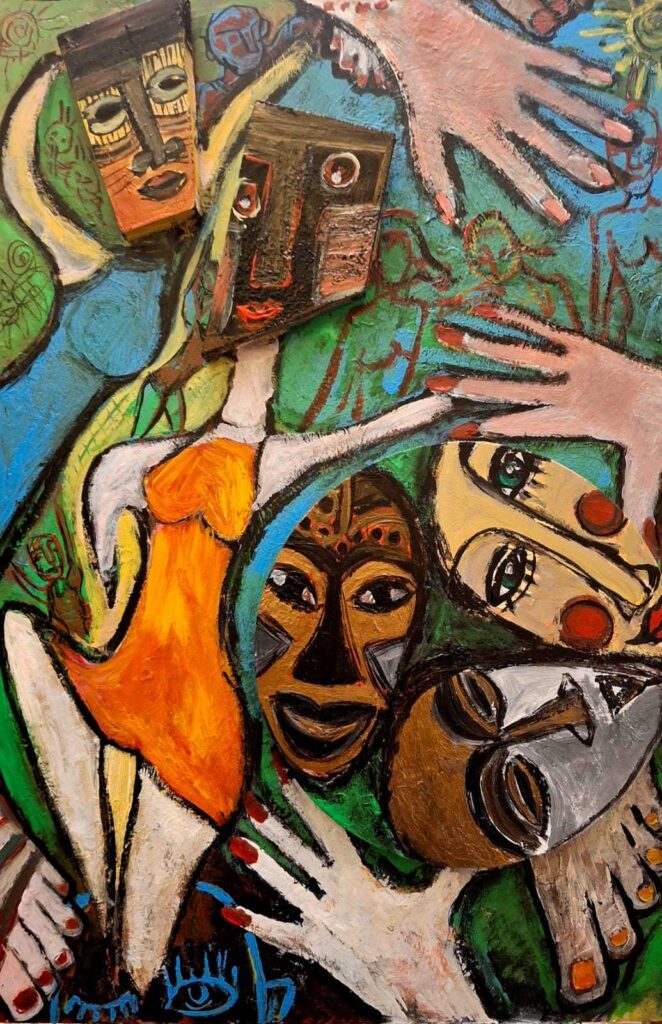

Der Faden der Erinnerung: Reflexionen, Berührungen, Projektionen
In der Welt der KI und des Internets haben die Menschen immer noch eine Leidenschaft für die Schatzsuche, das Aufdecken von Geheimnissen und dem Unbekannten, das Entwirren und Erforschen des Flüchtigen. Wenn wir den Schatz selbst nicht besitzen können, wollen wir zumindest seine Geschichte und sein Geheimnis kennen, ihn verstehen und ihn uns zu eigen machen.
Die Muse und das Thema meiner Kreationen ist vielleicht der bekannteste, allgemein geliebte und gefürchtete prähistorische Fund, die Venus von Willendorf. Sie selbst ist eine prähistorische Kalksteinstatue mit winzigen Muscheleinschlüssen, die ein ungarischer Archäologe am Ufer der österreichischen Unterdonau in der Siedlung Willendorf gefunden hat und die die Frau selbst in blockartiger, geradezu kompakter Form darstellt.
Trotz der laufenden wissenschaftlichen Forschung birgt die Statue – ebenso wie die Frau und ihr Frausein – immer noch ein Geheimnis. Wen und warum stellt diese Statue dar, warum fasziniert sie den heutigen Betrachter mit ihrer unverhüllten Weiblichkeit, ihrer Nacktheit, ihrer sanften, zurückhaltenden und doch üppigen und fürsorglichen Aura?
Ihre Präsenz ist stark, packend. Totem. Amulett. Es passt in die Hand. Tragen wir es mit uns. Aber was sagt es aus, und was sagt es dem heutigen Betrachter – über Weiblichkeit, Weiblichkeit, weibliche Identität, Mutterschaft, Autonomie, Gemeinschaft und ganz allgemein über Geschichte und das Geschichtsschreiben selbst? Diese Fragen werden in meinen Arbeiten in Gemälden und Reliefs diskutiert, erläutert und reflektiert.
Die Ausstellung lässt sich thematisch in drei Teile gliedern:
I. Erinnerungsfäden
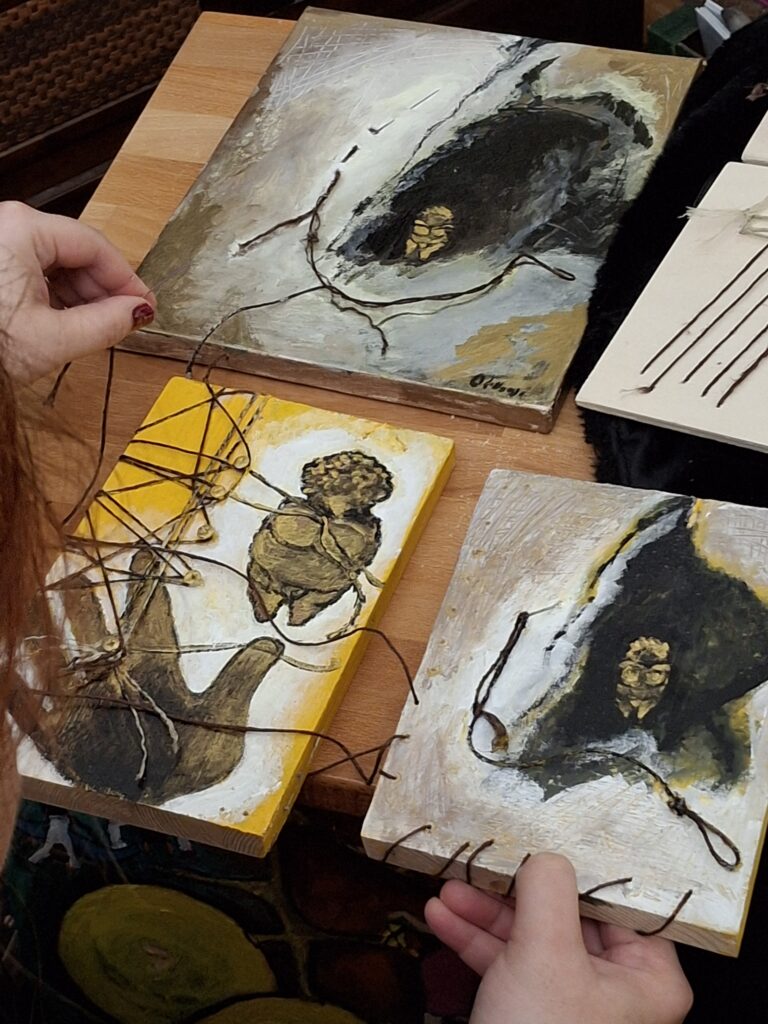
Die Höhle, die als Riss oder Riss auf der Leinwand erscheint, der Faden, der daneben enge Stiche bildet, und die Nadel, die die Leinwand durchsticht, stellen einerseits die Wunde, die Narben, die Wundheilung dar, andererseits eine individuelle Geschichte, die aus anspruchsvollen Stücken gewebt ist die Vergangenheit. Das Bild trägt die Dualität von natürlichem Schmerz und Stärke in sich, die Teil der weiblichen Identität und des Frauseins ist, den Prozess der Selbstheilung, die Fähigkeit zur Erneuerung und Regeneration, einerseits die akribische Arbeit des Geschichtsschreibens, andererseits die Zusammenfügen von Mosaiken, Fragmenten und zerbrechlichen Stücken, das Weben und Zusammennähen der Geschichte.
II. Reflexionen, Berührungen, Projektionen
Der Erinnerungsfaden drückt auch die Verbindung des Betrachters zur antiken Figur aus, der Faden ist die Verbindung zwischen Vergangenheit und Gegenwart. Redest du mit uns? Was ist Ihre Botschaft? Die der Venus zugewandte Handfläche erinnert an die mystische Kraft der antiken, kraftvollen, kompakten, blockartigen Figur der Venus, ein Symbol für Mutter Erde, Fruchtbarkeit und natürliche Kraft, bekannt als schützendes Totem mit dem Faden der Erinnerung.
Auch heute noch sind Handabdrücke ein direkter Ausdruck von Berührung und Gefühl und bilden gleichzeitig eine Verbindung zwischen dem modernen Betrachter und Betrachter und dem ehemaligen, antiken Betrachter.
Die Silhouetten der Palmen wurden durch Archäologie und Ethnographie als typische prähistorische Darstellungen der neolithischen Gravetti-Kultur identifiziert, und die Darstellung könnte während einer Zeremonie oder Zeremonie angefertigt worden sein, die einen rituellen Zweck hatte und gemeinschaftsbildende Kraft verlieh.
Ein Eindruck oder Zeichen, das während der Anwesenheit und Anwesenheit der Gemeinschaft hinterlassen wird und dessen Zweck entweder Danksagung oder Trauer ist, ist definitiv eine gemeinsame Zeremonie, die die Gruppenzugehörigkeit zum Ausdruck bringt.
Genau wie die Berührungen, Hände und Finger, die auf den Werken erscheinen, spinnt und kreiert der Betrachter seine eigene, individuelle Geschichte rund um die Figur der Venus.
Mit unseren Verbindungen bilden wir jedoch alle eine Gemeinschaft mit Bindungen, Gefühlen und Erinnerungen an die Frau und Mutter.
III. Suchen Sie nach der Frau!
Der dritte Teil der Serie, getrennt von den klassischen Venusbildern, besteht aus Ikonen, die die moderne Frau in Form des Venustotems und seiner Macht darstellen. Selbstzeit, Schönheit und Gesundheitsbewusstsein, Autonomie, Akzeptanz und das Geheimnis, das Mysterium, das die Weiblichkeit für immer und zeitlos definiert, eine fesselnde Kraft, die selbst in ihrer Nacktheit eine aufregende Geschichte verbirgt, ist selbst in ihrer flüchtigen, materiellen Form schwer zu fassen .”
(Copyright: Viktoria Villanyi,2024)

HUN
INTERJÚ A MŰVÉSSZEL-THE ARTIST CHAMBER (MŰVÉSZTEREM), 2026. április 23.
Mi határozza meg, kik vagyunk, és hogyan mutatható meg, őrizhető meg ez az identitás a művészeten keresztül? A Budapesti kiállítótérként működő The Artist Chamber ÖRÖKSÉG című kiállítása a kérdést vizsgálva, 50 kortárs alkotó munkáin át mutatta be a magyar kultúra mozaikját irodalmunk, zenéink, tudósaink és történelmünk ikonjaiból, túlnyúlva a nemzeti identitás határain. A tárlatnak a Zágrábi Liszt Intézet adott otthont 2026. február 19. – március 17. között. A szakmai zsűri egyik különdíját nyert alkotóval Villányi Viktóriával beszélgetett az Artist Chamber, alkotói útról, inspirációkról, és a Zágrábban kiállított művekről.
A művészről
Villányi Viktória mixed media képzőművész, művészettörténész és képzett jogász. Viktória festményeit és 3D-s vegyes technikájú alkotásait az elmúlt években elsősorban kortárs csoportos kiállításokon mutatta be Madridban, Spanyolországban és szülőhazájában, Magyarországon, valamint a közelmúltban Rómában és Párizsban rendezett kiállításokon, továbbá brazíliai és brit kortárs művészeti pályázatokon.Művészetének fő ihletforrásai Közép-Európa-, az Ibériai-félsziget- és Latin-Amerika ősi formái és nyomai, valamint kulturális hagyományai.
„MI AZ ELSŐ MŰVÉSZETTEL, VAGY ALKOTÁSSAL KAPCSOLATOS EMLÉKED?
A terpentin olaj illata egy festő műhelyben, Óbudán, az akkor ott működő Gyémánt László festőművész hallgatói köre tanított gyerekeket festeni, köztük engem is. Ott engem teljesen magával ragadott az olajfesték fenyőgyanta-szerű illata, a műterem hangulatos szűrt fénye, az ottfelejtett drapériák és tárgyak történetei.
Első alkalommal a műteremben felolvasták nekünk Antoine de Saint-Exupéry: A Kis Herceg prológjából azt a részt, amikor a kényszerleszállást végrehajtó pilóta a Kis Hercegnek egy sor bárányt rajzol a jegyzetfüzetébe. A Kis Hercegnek végül az a rajz nyeri el a tetszését, amiben a szóban forgó bárány helyett ravaszul „bárányt tartalmazó ládát” rajzol a pilóta. Merthogy a Kis Herceg így saját maga bele tudja képzelni a tökéletes bárányt, úgy, ahogy őneki megfelel.
Ez a szabad fantázia. Az absztrakció és a minimalizmus alapgondolatai. Saint-Exupery azóta is egy kedvenc íróm, és több képemben tetten érhetők a gondolatai, vagy témái.
Van egy teljes Saint-Exupéry-nek dedikált festmény ciklusom is, egy darabja, az „Aviátor” jelenleg Madridban van kiállításon.
MESÉLJ EGY KICSIT A KÉT, PÁL UTCAI FIÚK-IHLETTE MUNKÁDRÓL, AMIK ZÁGRÁBBAN KERÜLTEK KIÁLLÍTÁSRA.
Szeretem a gyerekek világát—felnagyít sok dolgot, szókimondó, őszinte, ugyanakkor naiv, kíváncsi, kimondja, amit gondol. Vonzó ezt vászonra, fára megfesteni. Hogyan játszanak, a világgal, egymással, és velünk. Mit mondanak, mit üzennek?
A képeken megjelenő üveggolyók a gyerekek jelenét és a távoli perspektívát jelenítik meg. Az aranykrómmal festett üveggolyókban mi is tükröződünk, a Pál utcai fiúk képében magunkat is látjuk. Az üveggolyók törékenyek, tűnékenyek, a festményben a gyerekek alakjai közt nyugtalanságot, a vonallal körbehatárolt terek közt feszültséget teremtenek.
A tértörések, mint például a Grund és a Füvészkert felülnézeti rajzai, az eltérő idősíkokat jelzik. Utalnak arra, ami a múltban történt, és ami történni fog. Az aranykróm elemekkel az 1890-es évekre is utalok: a meseszerű, elillanó, szecessziós világra, amit a regényben a verkli hangja érzékeltet.
Szeretem Molnár Ferenc érzékenyen megformált gyerek-karaktereit. Fiatalon írta ezt a regényt, mégis részleteiben kiforrt, olyan mű, ami érezhetően sokáig érlelődött benne. Erősen érzelmekre ható, őszinte hangú. Néha nyers fordulatokkal, és mélyen tépelődő, sebezhető, ezért hiteles karakterekkel.
Zseniálisan időszerű. Minden társadalomban van Nemecsek, Boka, Csónakos, Geréb, Áts Feri.
SOK KÉPEDBE EXPRESSZÍV SZIMBÓLUMOKAT? FOLKLÓR, NATÍV ÉRZETŰ ELEMEKET ÉPÍTESZ BE. MENNYIRE TUDATOS EZ A MAGÁNMITOLÓGIA? HA GONDOLOD, EMELJ KI NÉHÁNY SZEMÉLYES SZIMBÓLUMOT.
A képeimben testet ölt egy ősi természetkultusz, vagy ha tetszik, sámán-világ. A látásmódomat egyrészt a saját Közép-Európai hagyományaink, másrészt az egyetemi éveim alatt megélt, megismert latin-amerikai kultúra spirituális jellege alakította. Diákként hat évet töltöttem Latin-Amerikai közösségben Bostonban, az Egyesült Államokban, és a mai napig vannak Madridban spanyol és latin-amerikai barátaim, művészek és kurátorok, akikkel csoportos kiállításokon együttműködöm.
A latin-amerikai kultúrák eredendően nem eszköznek és fogyasztásra szánt erőforrásnak tekintik a Földet, a természetet, növény-és állatvilágot és minden természeti jelenséget. Számomra ez a látásmód különleges értéket hordoz, a Föld és természeti erők iránti tisztelet gyakran megjelenik az alkotásaimban, személyes formavilágomban ölt testet. Alapeleme a barlang, vagy az arra rímelő szájüreg, mindkettő a születés, fogantatás, kezdet jele.
A földkorong a festményeimben néhol tükörként, néhol a néző által forgatható, mozgó tárcsaként jelenik meg. A forgás a ciklikusságot, a Föld magába való visszatérését, megújulását jelzi. Ha a korongot tükörsima, arany felülettel festem meg, amely tükrözi a napot, akkor a Föld tükröződésében magunkat is láthatjuk. A Föld mint ember-arcú, hatalmas totem-szerű lény, több képemben megjelenik. Például a Szent Ferenc című képemben hatalmas, erőteljes, koponya-szerű, antropomorf figuraként, a természetet tisztelő apró szent alakja mellett. Hasonlóképpen látható a Föld, mint egy emberi arc, ami nagy barlangszerű szájjal, a körülötte futkosó, barlangrajzokra emlékeztető kis harcosok és vadvilág közt, a Sikoly c. képemben.
Jellemzőek a képeimben az ősi barlangrajzokat idéző kéznyomok is, ezek a saját gesztusaim és lenyomataim. Előfordulnak a szemlélőt tapintásra ingerlő szőrös, bolyhos részletek, például műszőrméből készült hatalmas 3D bogarak, poszméhek, beporzók, ahogy a földet megjelenítő méhkaptár körül zizegnek. Több festményem már kifejezetten a Közép-Európai kulturális hagyatékból táplálkozik, egyfajta pogány-keresztény kettősség szövi át őket. Az őserő, női erő, a születés misztikuma, egyben a védelmező energia szimbóluma a festményeimben megjelenő Willendorfi Vénusz alakja, az európai Gravetti-kulturából származó, mindössze tíz centis kis mészkőszoboré, amelynek külön ciklust dedikáltam. A címadó „idő fonala” az emberiséget a Földdel összekapcsoló köldökzsinór, ami jelzi az egymásra utaltságunkat, kölcsönös felelősségünket. Másrészt az idő fonala a közösségi emlékezet és a kultúra hálója, ami összetart bennünket.
LATIN-AMERIKAI TÖRTÉNELMET ÉS IRODALMAT IS TANULTÁL: MIT JELENT SZÁMODRA EZ A KULTÚRA? HOGYAN TEKINT PÉLDÁUL A MŰVÉSZETRE (A NYUGATI PERSPEKTÍVÁHOZ KÉPEST)?
Az ősi Latin-Amerikai kultúrák a minket körülvevő élővilágot, és magát a Földet, egykor spirituális erővel ruházták fel, és erre az erőre ma is tisztelettel tekintenek. Ezért ma is vannak szent állatok, misztikus erővel bíró tájak, például hegyek és barlangok, a természeti kincsekhez alapvetően tisztelettel nyúlnak. Ez a viszonyulás nem „múlt el” az európai gyarmatosítást, kulturális szintézist követően sem, 2026-ban is vannak hagyományok, amelyek napjainkban – a vizuális művészetben, zenében, táncművészetben, vagy irodalomban – tovább élnek.
A latin-amerikai kultúra sajátja a ciklikus idő-fogalom, a halálhoz kapcsolódó újjászületés alapgondolata. Ahhoz, hogy a halál és újjászületés természetes egyensúlya fennmaradjon, a természetnek vissza kell adni, amit kaptunk tőle, és ha az ember nem tesz ennek eleget, a természeti erők visszaveszik, ami nekik jár. Az Európai kultúrában kevésbé volt és van jelen a természet tisztelete. A Földet mint puszta fogyó erőforrást és eszközt uraljuk, nem ruházzuk fel spirituális jelleggel. A mi európai szemléletünkben a Föld puszta matéria, ami nem fog, nem tud minket számon kérni.
KIK AZOK A MŰVÉSZEK VAGY MESTEREK, AKIK MEGLÁTÁSOD SZERINT HATOTTAK RÁD? MIBEN TUDNÁD EZT A HATÁST MEGRAGADNI?
Magaménak érzem az expresszív szürrealizmust egészen az art-brut vonulatig. Szeretem Chagall és Paul Klee munkásságát, és Jean Dubuffet-t. Példaképnek elsősorban Marc Chagallt tekintem, minden mesterkéltséget elvető, spontán, buja színvilágú, játékos, mégis egyensúlyt árasztó festményeit. Magukban hordozzák mindazt a teljességet, ön-identitást, kulturális azonosságot, belülről fakadó Isten-hitet, kultúra és közösség iránti szeretetet és tiszteletet, ami egyedivé teszi a munkáit, és ami a mai napig értéket hordoz, közvetít, a szemlélőnek. A képeimben, például a Bor filozófiája/TILTOTT GYÜMÖLCS ciklusban a nyers alapszínek használata, a markáns, lényegi elemekre bontott formák, a nyüzsgő, dinamikus kompozíciók, a meseszerű emberi alakok elmosódott sziluettje, a melegséget árasztó, füstös-hatású, misztikus-spirituális tájak mind tükrözik Chagall hatását.
A hazai festészetben közel áll hozzám Galambos Tamás bibliai tematikájú munkássága, amelyet egy tokaji nyári látogatás alatt fedeztem fel. A képeiben mintha a saját gondolataimat, érzéseimet ismertem volna fel. Magával ragadott a különleges humorú, mesterkéletlen, de míves, gótikát idéző, szatirikus-szürrealista világa. Érdekesnek tartom a fiatalabb generációs kortárs alkotók közt Duliskovich Bazil (anti)ikonfestészetét, Péterffy Ábel ikon-kollázsait, Boros Viola biblikus-profán témájú Édenkertjeit.
Kompozíció és térszerkesztés szempontjából több hazai grafikusművész munkáit, köztük Szalay Lajos, Hincz Gyula, Kass János, Kondor Béla műveit is szeretem. Hatásuk – főleg Kondor Béláé – tetten érhető a festményeimben megjelenő strukturált „koordinátákban”, néhol a fordított síkok, a felülnézeti rajzok, a térképek, a feldarabolt terek alkalmazásában. Persze a példaképeim és kedvelt művészeim hatása nem mindig kézzel fogható, vagy érhető tetten konkrét tárgyi elemekben. Ugyanúgy, ahogy egy jó regény, vers, vagy zenemű, a képzőművészet elemi erővel hat: gondolatot ébreszt bennem és alkotásra késztet.”
(2026. április 23)
EN
INTERVIEW WITH THE ARTIST BY THE ARTIST CHAMBER (MŰVÉSZTEREM), 23 April, 2026
What defines who we are, and how can this identity be shown and preserved through art? The Artist Chamber, an exhibition space in Budapest, examined this question with its exhibition titled HERITAGE, presenting the mosaic of Hungarian culture through the works of 50 contemporary artists, including icons of our literature, music, scientists and history, transcending the boundaries of national identity. The exhibition was hosted by the Liszt Institute in Zagreb between February 19 and March 17, 2026. The Artist Chamber, in the following interview, talks with Viktória Villányi, who won one of the special awards of the art jury, on her creative trajectory, cultural identity and heritage issues, and sources of inspiration, also addressing her two of her recents works now exhibited in Zagreb.
About the artist
Viktória Villányi is a mixed media artist, art historian and qualified lawyer. In recent years, Viktória has presented her paintings and 3D mixed media works primarily in contemporary group exhibitions in Madrid, Spain and her native Hungary, as well as in recent exhibitions in Rome and Paris, as well as in contemporary art competitions in Brazil and the UK.The main sources of inspiration for her art are the ancient forms and traces, as well as the cultural traditions of Central Europe, the Iberian Peninsula and Latin America.
YOU INCORPORATE EXPRESSIVE SYMBOLS, ELEMENTS WITH A FOLKLORE/NATIVE FEEL INTO MANY OF YOUR PAINTINGS. HOW CONSCIOUS IS THIS „PRIVATE MYTHOLOGY”? IF YOU THINK ABOUT IT, CAN YOU HIGHLIGHT SOME OF YOUR PERSONAL SYMBOLISM?
An ancient nature cult, or if you like, a shamanic world, is embodied in my paintings. My perspective was shaped on the one hand by our own Central European traditions, and on the other hand by the spiritual nature of the Latin American culture I experienced and learned about during my university years. As a student, I spent six years in a Latin American community in Boston, USA, and to this day I have Spanish and Latin American friends, artists and curators in Madrid with whom I collaborate on group exhibitions.
Latin American cultures inherently do not view the Earth, nature, flora and fauna, and all natural phenomena as tools and resources intended for consumption. For me, this vision holds special value, the respect for the Earth and natural forces often appears in my works, it is embodied in my personal world of forms. Its basic element is the cave, or the mouth, the oral cavity that rhymes with it, both are signs of birth, conception, and beginning.
The Earth disc appears in my paintings sometimes as a mirror, sometimes as a moving disc that can be rotated by the viewer. The rotation indicates cyclism, the return and renewal of the Earth into itself. If I paint the disk with a mirror-smooth, golden surface that reflects the sun, then we can see ourselves in the reflection of the Earth.
The Earth, as a human-faced, huge totem-like being, appears in several of my paintings. For example, in my painting Saint Francis, it appears as a huge, powerful, skull-like, anthropomorphic figure, next to the figure of a small saint who respects nature. Similarly, the Earth is seen as a human face with a large cave-like mouth, among the small warriors and wildlife running around it, reminiscent of cave drawings, in my painting Scream.
The symbol of primal power, feminine power, the mysticism of birth, and also protective energy that appears in my paintings is the figure of the Venus of Willendorf, a small limestone statue of only ten centimeters from the European Gravetti culture, to which I dedicated a separate cycle. The titular “thread of time” is the umbilical cord connecting humanity to the Earth, which indicates our interdependence and mutual responsibility. On the other hand, the thread of time is the web of community memory and culture that holds us together.
The handprints reminiscent of ancient cave drawings are also characteristic of my paintings; these are my own gestures and impressions.
Then, there are furry, fluffy details that stimulate the viewer to touch, such as huge 3D bugs made of faux fur, bumblebees, pollinators, as they buzz around the beehive representing the earth. Several of my paintings are specifically nourished by the Central European cultural heritage, a kind of pagan-Christian duality weaves through them.
YOU STUDIED LATIN AMERICAN HISTORY AND LITERATURE. WHAT DOES THIS CULTURE MEAN TO YOU, HOW DO YOU ENVISION ITS RELATION TO ART, IN COMPARISON TO A EURO-CENTRIC, EUROPEAN PERSPECTIVE?
Ancient Latin American cultures once endowed the living world around us, and the Earth itself, with spiritual power, and they still view this power with respect today. That is why even today there is a cultural respect for ancient sacred animals, landscapes with mystical power, such as mountains and caves, and they fundamentally respect natural treasures. This attitude did not “pass away” even after European colonization and cultural synthesis; even in 2026, there are traditions that continue to live on today – in visual art, music, dance, or literature.The concept of cyclical time and the basic idea of rebirth associated with death are characteristic of Latin American culture.
In order for the natural balance of death and rebirth to be maintained, nature must give back what we have received from it, and if man does not do this, the forces of nature will take back what is due to them. In European culture, respect for nature was and is less present. We rule the Earth as a mere finite resource and tool, we do not endow it with a spiritual character. In our European perspective, the Earth is mere matter, which will not, cannot hold us accountable.
WHO ARE THE ARTISTS OR MASTERS WHO HAVE INFLUENCED YOUR VISION, AND IN WHAT WAY CAN YOU CAPTURE SUCH INFLUENCE IN YOUR WORKS?
I feel that expressive surrealism, right up to the art-brut trend, is closest to my vision. I love the work of Chagall and Paul Klee, and Jean Dubuffet. I primarily consider Marc Chagall as a master and as my icon, rejecting all artifice, his paintings are spontaneous, lush in color, playful, yet radiating balance. They carry within them all the completeness, self-identity, cultural identity, faith in God from within, love and respect for culture and community, which makes his works unique, and which still carries value, conveys it to the viewer. In my paintings, for example in the Philosophy of Wine/FORBIDDEN FRUIT cycle, the use of raw primary colors, the striking, essential forms broken down into essential elements, the lively, dynamic compositions, the blurred silhouette of fairy-tale human figures, the warm, smoky, mystical-spiritual landscapes all reflect Chagall’s influence. There are, of course, several contemporary artists, in graphic art, painting and other media, in my country, whose work I enjoy and find inspiring, as well as Iberian and Latin American contemporary arstist whose works I find close to my own perspective and artistic vision.
WHAT IS YOUR FIRST MEMORY RELATED TO ART OR CREATIVE PROCESS?
The smell of turpentine oil in a painting workshop in Óbuda, where the circle of students of the painter László Gyémánt, who was working there at the time, taught children to paint, including me. There I was completely captivated by the pine-resin smell of oil paint, the cozy filtered light of the studio, the stories of the draperies and objects left by chance there.For the first time in the studio, our instructor read part of the prologue of Antoine de Saint-Exupéry’s The Little Prince, where the pilot– who is lost in the desert after a forced landing– draws a series of sheep in his notebook for the Little Prince. After a set of attempts, the pilot cleverly draws a “box containing the sheep” instead of the sheep in question. Now the Little Prince can imagine the perfect sheep himself, in a way that suits him. This is a story about free imagination. The basic ideas of abstraction and minimalism. Saint-Exupéry has been a favorite writer of mine ever since, and his thoughts or themes can be seen in several of my paintings. I also have an entire cycle of paintings dedicated to Saint-Exupéry, one of which, „The Aviator,” is currently on display in Madrid.
TELL US ABOUT THE TWO WORKS INSPIRED BY „THE BOYS OF PAL STREET”, NOW EXHBITED IN ZAGREB
I love the world and perspective of children. They magnify many things, they are outspoken, honest, yet naive, curious, they say what they think. It is attractive to paint this on canvas, on wood. How do they play with the world, with each other, and with us. What do they have to say, what message they send to us.The glass marbles appearing in the pictures represent the presence of children and the globe, as distant future. We, the spectators, are also reflected in the surface of the glass balls that I painted with gold chrome, so, on one hand, we see ourselves in the image of the boys. The glass balls are fragile, ephemeral, they create restlessness between the figures of the children in the painting, tension between the spaces delimited by lines.The breaks in space, such as the top-view drawings of the Grund and the Botanical Garden, indicate different time planes. They refer to what happened in the past and what will happen. With the gold-chrome elements, I also refer to the 1890s: the fairy-tale, evanescent, Art Nouveau world that the sound of the merry-go-round in the novel conveys. I love Ferenc Molnár’s sensitively formed child characters.He wrote this novel when he was young, yet it is mature in its details, a work that has noticeably matured in him for a long time. It has a strong emotional impact, a sincere tone. Sometimes with raw turns, and deeply struggling, vulnerable, and therefore authentic characters, it is geniusly timely: every society has characters like his child heroes.


Article in Issue No.5 2024 of ARTIO MGAGAZINE, by Director Bisa Bennett:


The threads of memory: reflections, touches, projections
(Author: Viktoria Villanyi, 2024)
In the world of AI and the Internet, people still have a passion for treasure hunting, unraveling mysteries and the unknown, untangling and exploring the elusive. If we cannot own the treasure itself, at least we want to know its history and mystery, understand it, and make it our own.
The muse and subject of my creations is perhaps the most well-known, universally loved and feared prehistoric find, the Venus of Willendorf. She herself is a prehistoric limestone statue interspersed with tiny shell inclusions found by a Hungarian archaeologist on the banks of the Austrian Lower Danube, in the settlement of Willendorf, which depicts the Woman herself in a block-like, frankly compact form.
Despite the ongoing scientific research, the statue – like the woman and being a woman – still hides a secret. Who and why does this statue represent, why does it captivate today’s observer, with its undisguised femininity, its nakedness, its gentle, restrained, yet abundant and caring aura?
Her presence is strong, gripping. Totem. Amulet. It fits in the hand. Let’s carry it with us. But what does it say, and what does it say to today’s observer–about femininity, femininity, female identity, motherhood, autonomy, community, and in general, about history and history writing itself? These questions are discussed, explained, and reflected in my works contained in paintings and reliefs.
The exhibition can be divided into 3 parts, according to themes:
I. Threads of memory
The cave that appears as a crack or tear on the canvas, the thread forming tight stitches next to it, and the needle piercing the canvas depict the wound, scars, wound healing, on the other hand, an individual story woven from ambitious pieces of the past. The image carries within itself the duality of natural pain and strength that is a part of female identity and being a woman, the process of self-healing, the ability to renew and regenerate, on the one hand the meticulous work of history writing, the joining together of mosaics, fragments, and fragile pieces, the weaving and sewing together of the story.
II. Reflections, touches, projections
The thread of memory also expresses the viewer’s connection to the ancient figure, the thread is the connection between the past and the present. Are you talking to us? What is your message? The palm turned towards Venus evokes the mystical power of the ancient, powerful, compact, block-like figure of Venus, a symbol of Mother Earth, fertility and natural power, known as a protective totem with the thread of memory.
Even today, palm prints are a direct expression of touch and feel, and at the same time they form a link between the modern observer and viewer and the former, ancient observer.
The silhouettes of the palms have been identified by archeology and ethnography as typical prehistoric depictions of the Neolithic Gravetti culture, and the depiction may have been made during a ceremony or ceremony that had a ritual purpose and gave community-forming power.
An impression or sign left during the community’s presence and presence, the purpose of which is either thanksgiving or mourning, is definitely a joint ceremony expressing group belonging.
Just like the touches, hands, and fingers that appear on the works, the observer weaves and creates his own individual story related to the figure of Venus.
However, with our connections, we all form a community, with attachments, feelings and memories to the Woman and Mother.
III. Look for the Woman!
The third part of the series, separated from the classic Venus images, is made up of icons depicting the modern woman in the form of the Venus totem and its power. Self-time, beauty and health-consciousness, autonomy, acceptance, and the secret, mysteriousness that forever and timelessly defines femininity, a captivating force that hides an exciting story even in its nakedness, is difficult to grasp even in its volatile, material form.”
Az emlékezet fonala: reflexiók, tapintások, tükröződések
(Szerző: Villányi Viktória, 2024)
Az AI és net világában ma is él az emberben a kincskeresés, a rejtély és ismeretlen megfejtése, a megfoghatatlan kibogozása, feltárása iránti szenvedély. Ha magát a kincset ugyan nem birtokolhatjuk, legalább annak történetét, rejtélyét szeretnénk megismerni, megérteni, magunkévá tenni.
Alkotásaim múzsája és tárgya a mai napig talán legismertebb, világszerte szeretett és féltett őskori lelet, a Willendorfi Vénusz. Ő maga az osztrák Alsó-Duna partján, Willendorf településen egykor egy magyar régész kutató által fellelt őskori, apró kagyló zárványokkal tarkított mészkő szobor, mely tömb-szerűen, szókimondóan kompakt formában ábrázolja magát a Nőt.
A jelenleg is szakadatlanul folyó tudományos kutatások ellenére, a szobor–ahogy a nő, és női lét– továbbra is titkot rejt. Kit, miért ábrázol ez a szobor, miért ragadja meg a mai szemlélőt, a leplezetlen nőiségével, meztelenségével, szelíd, visszafogott, mégis bőséget, gondoskodást árasztó aurájával?
Jelenléte erős, megragad. Totem. Amulett. Belefér a kézbe. Hordozzuk magunkkal. De hogyan szól, és mit mond a mai szemlélőnek–a nőiségről,-a nőiségről, női identitásról, anyaságról, autonómiáról, közösségről, és egyáltalán, a történetéről és magáról a történetírásról? E kérdéseket feszegetik, fejtik, erre reflektálnak festményekbe és reliefekbe foglalt alkotásaim.
A kiállítás 3 részre osztható, tematikák szerint:
I. Az emlékezet fonala / Threads of memory
A vásznon repedésként, szakadásként megjelenő barlang, a mellette szoros öltéseket képező fonál és a vásznat áttörő tű a sebet, hegeket, a sebgyógyulást jeleníti meg, másfelől a múlt törekédes darabjaiból szőtt egyéni történetet. A kép magában hordozza a női identitásban, női lét részét képező természetes fájdalom és erő kettősségét, az öngyógyítás folyamatát, a megújulás és regenerálódás képességéét, másfelől a történetírás aprólékos munkáját, a mozaikokból, töredékekből álló részletek, törékeny darabok összeillesztését, a történet szövését, összevarrását.
II. Tükröződések, tapintások, projekciók
Az emlékezet fonala egyben kifejezi a néző, szemlélő kapcsolódását az ősi alakhoz, a fonál a kapcsolat a régmúlt és jelen közt. Beszél hozzánk? Mi az üzenete? A Vénusz felé fordított tenyér az emlékezet fonalával az ősi, erőteljes, kompakt, tömb-szerű Vénusz-figura, a Föld-anya, termékenység és természeti erő szimbólumaként, védelmező totemként ismert szobor misztikus erejét hívja elő.
A tenyér lenyomatok ma is közvetlen kifejezései az érintésnek, tapintásnak, egyben kapcsot képeznek a modern szemlélő, néző és az egykori, ősi szemlélő közt.
A tenyér sziluettjeit az archeológia és néprajz a neolitikumi Gravetti-kultúra jellegzetes őskori ábrázolásaiként azonosította, az ábrázolás feltehetően rituális célzatú, a közösségformáló erőt adó ceremónia, szertartás során készülhetett.
A közösség együttléte, jelenléte során hagyott lenyomat, jel, melynek célja akár hálaadás, akár gyász, mindenképpen a csoportos összetartozást kifejező, együttes szertartás.
A szemlélő, akárcsak az alkotásokon megjelenő érintések, kezek, ujjak, saját maga szövi, alkotja a Vénusz-alakhoz kapcsolódó egyéni történetét.
Kapcsolódásainkkal azonban mindannyian egy közösséget alkotunk, a Nőhöz, Anyához való kötődésekkel, érzésekkel, emlékekkel.
III. Keresd a Nőt!
A sorozat harmadik részét a klasszikus Vénusz-képektől elszakadva a Vénusz-totem formájában, erejében a modern nőt megjelenítő ikonok képezik. Az én-idő, szépség-és egészség-tudat, autonómia, elfogadás, és a nőiséget örökké, időtlenül meghatározó titok, titokzatosság, meztelenségében is izgalmas történetet rejtő, illékony, materiális formájában is nehezen megfogható, magával ragadó erő.”


Der Faden der Erinnerung: Reflexionen, Berührungen, Projektionen
(Copyright: Viktoria Villanyi,2024)
In der Welt der KI und des Internets haben die Menschen immer noch eine Leidenschaft für die Schatzsuche, das Aufdecken von Geheimnissen und dem Unbekannten, das Entwirren und Erforschen des Flüchtigen. Wenn wir den Schatz selbst nicht besitzen können, wollen wir zumindest seine Geschichte und sein Geheimnis kennen, ihn verstehen und ihn uns zu eigen machen.
Die Muse und das Thema meiner Kreationen ist vielleicht der bekannteste, allgemein geliebte und gefürchtete prähistorische Fund, die Venus von Willendorf. Sie selbst ist eine prähistorische Kalksteinstatue mit winzigen Muscheleinschlüssen, die ein ungarischer Archäologe am Ufer der österreichischen Unterdonau in der Siedlung Willendorf gefunden hat und die die Frau selbst in blockartiger, geradezu kompakter Form darstellt.
Trotz der laufenden wissenschaftlichen Forschung birgt die Statue – ebenso wie die Frau und ihr Frausein – immer noch ein Geheimnis. Wen und warum stellt diese Statue dar, warum fasziniert sie den heutigen Betrachter mit ihrer unverhüllten Weiblichkeit, ihrer Nacktheit, ihrer sanften, zurückhaltenden und doch üppigen und fürsorglichen Aura?
Ihre Präsenz ist stark, packend. Totem. Amulett. Es passt in die Hand. Tragen wir es mit uns. Aber was sagt es aus, und was sagt es dem heutigen Betrachter – über Weiblichkeit, Weiblichkeit, weibliche Identität, Mutterschaft, Autonomie, Gemeinschaft und ganz allgemein über Geschichte und das Geschichtsschreiben selbst? Diese Fragen werden in meinen Arbeiten in Gemälden und Reliefs diskutiert, erläutert und reflektiert.
Die Ausstellung lässt sich thematisch in drei Teile gliedern:
I. Erinnerungsfäden
Die Höhle, die als Riss oder Riss auf der Leinwand erscheint, der Faden, der daneben enge Stiche bildet, und die Nadel, die die Leinwand durchsticht, stellen einerseits die Wunde, die Narben, die Wundheilung dar, andererseits eine individuelle Geschichte, die aus anspruchsvollen Stücken gewebt ist die Vergangenheit. Das Bild trägt die Dualität von natürlichem Schmerz und Stärke in sich, die Teil der weiblichen Identität und des Frauseins ist, den Prozess der Selbstheilung, die Fähigkeit zur Erneuerung und Regeneration, einerseits die akribische Arbeit des Geschichtsschreibens, andererseits die Zusammenfügen von Mosaiken, Fragmenten und zerbrechlichen Stücken, das Weben und Zusammennähen der Geschichte.
II. Reflexionen, Berührungen, Projektionen
Der Erinnerungsfaden drückt auch die Verbindung des Betrachters zur antiken Figur aus, der Faden ist die Verbindung zwischen Vergangenheit und Gegenwart. Redest du mit uns? Was ist Ihre Botschaft? Die der Venus zugewandte Handfläche erinnert an die mystische Kraft der antiken, kraftvollen, kompakten, blockartigen Figur der Venus, ein Symbol für Mutter Erde, Fruchtbarkeit und natürliche Kraft, bekannt als schützendes Totem mit dem Faden der Erinnerung.
Auch heute noch sind Handabdrücke ein direkter Ausdruck von Berührung und Gefühl und bilden gleichzeitig eine Verbindung zwischen dem modernen Betrachter und Betrachter und dem ehemaligen, antiken Betrachter.
Die Silhouetten der Palmen wurden durch Archäologie und Ethnographie als typische prähistorische Darstellungen der neolithischen Gravetti-Kultur identifiziert, und die Darstellung könnte während einer Zeremonie oder Zeremonie angefertigt worden sein, die einen rituellen Zweck hatte und gemeinschaftsbildende Kraft verlieh.
Ein Eindruck oder Zeichen, das während der Anwesenheit und Anwesenheit der Gemeinschaft hinterlassen wird und dessen Zweck entweder Danksagung oder Trauer ist, ist definitiv eine gemeinsame Zeremonie, die die Gruppenzugehörigkeit zum Ausdruck bringt.
Genau wie die Berührungen, Hände und Finger, die auf den Werken erscheinen, spinnt und kreiert der Betrachter seine eigene, individuelle Geschichte rund um die Figur der Venus.
Mit unseren Verbindungen bilden wir jedoch alle eine Gemeinschaft mit Bindungen, Gefühlen und Erinnerungen an die Frau und Mutter.
III. Suchen Sie nach der Frau!
Der dritte Teil der Serie, getrennt von den klassischen Venusbildern, besteht aus Ikonen, die die moderne Frau in Form des Venustotems und seiner Macht darstellen. Selbstzeit, Schönheit und Gesundheitsbewusstsein, Autonomie, Akzeptanz und das Geheimnis, das Mysterium, das die Weiblichkeit für immer und zeitlos definiert, eine fesselnde Kraft, die selbst in ihrer Nacktheit eine aufregende Geschichte verbirgt, ist selbst in ihrer flüchtigen, materiellen Form schwer zu fassen .”
Los Hilos de la memoria: reflejos, toques, proyecciones.
(Autor: Viktoria Villanyi, 2024)
En el mundo de la IA e Internet, la gente todavía siente pasión por la búsqueda de tesoros, desentrañar misterios y lo desconocido, desenredar y explorar lo esquivo. Si no podemos poseer el tesoro en sí, al menos queremos conocer su historia y su misterio, comprenderlo y hacerlo nuestro.
La musa y tema de mis creaciones es quizás el hallazgo prehistórico más conocido, universalmente amado y temido: la Venus de Willendorf. Ella misma es una estatua prehistórica de piedra caliza intercalada con pequeñas inclusiones de concha encontrada por un arqueólogo húngaro en las orillas del Bajo Danubio austríaco, en el asentamiento de Willendorf, que representa a la Mujer misma en una forma francamente compacta, parecida a un bloque.
A pesar de las investigaciones científicas en curso, la estatua, como la mujer y el ser mujer, todavía esconde un secreto. ¿A quién y por qué representa esta estatua, por qué cautiva al observador de hoy con su feminidad manifiesta, su desnudez, su aura dulce, sobria, pero al mismo tiempo abundante y cariñosa?
Su presencia es fuerte, apasionante. Tótem. Amuleto. Cabe en la mano. Llevémoslo con nosotros. Pero, ¿qué dice, y qué le dice al observador de hoy, sobre la feminidad, la feminidad, la identidad femenina, la maternidad, la autonomía, la comunidad y, en general, sobre la historia y la escritura de la historia misma? Estas preguntas son discutidas, explicadas y reflejadas en mis obras contenidas en pinturas y relieves.
La exposición se puede dividir en 3 partes, según temáticas:
I. Hilos de la memoria
La cueva que aparece como una grieta o un desgarro en el lienzo, el hilo que forma puntadas apretadas a su lado y la aguja que atraviesa el lienzo representan la herida, las cicatrices, la curación de las heridas, por otro lado, una historia individual tejida a partir de ambiciosas piezas de el pasado. La imagen lleva en sí la dualidad de dolor y fuerza natural que forma parte de la identidad femenina y del ser mujer, el proceso de autocuración, la capacidad de renovarse y regenerarse, por un lado el minucioso trabajo de escribir la historia, la unión de mosaicos, fragmentos y piezas frágiles, el tejido y costura de la historia.
II. Reflejos, toques, proyecciones.
El hilo de la memoria también expresa la conexión del espectador con la figura antigua, el hilo es la conexión entre el pasado y el presente. ¿Estás hablando con nosotros? ¿Cuál es tu mensaje? La palma vuelta hacia Venus evoca el poder místico de la antigua, poderosa, compacta figura en forma de bloque de Venus, símbolo de la Madre Tierra, la fertilidad y el poder natural, conocida como tótem protector con el hilo de la memoria.
Incluso hoy en día, las huellas de las palmas son una expresión directa del tacto y la sensación, y al mismo tiempo forman un vínculo entre el observador moderno y el observador antiguo.
Las siluetas de las palmeras han sido identificadas por la arqueología y la etnografía como representaciones prehistóricas típicas de la cultura Neolítica Gravetti, y la representación puede haber sido realizada durante una ceremonia o ceremonia que tenía un propósito ritual y otorgaba poder de formación de comunidades.
Una impresión o signo dejado durante la presencia y presencia de la comunidad, cuyo propósito sea de acción de gracias o de duelo, es definitivamente una ceremonia conjunta que expresa pertenencia al grupo.
Al igual que los toques, manos y dedos que aparecen en las obras, el observador teje y crea su propia historia individual relacionada con la figura de Venus.
Sin embargo, con nuestras conexiones, todos formamos una comunidad, con apegos, sentimientos y recuerdos a la Mujer y a la Madre.
III. ¡Busca a la Mujer!
La tercera parte de la serie, separada de las imágenes clásicas de Venus, se compone de iconos que representan a la mujer moderna en forma del tótem de Venus y su poder. El tiempo personal, la belleza y la conciencia de la salud, la autonomía, la aceptación y el secreto y el misterio que define para siempre y atemporalmente la feminidad, una fuerza cautivadora que esconde una historia apasionante incluso en su desnudez, son difíciles de captar incluso en su forma volátil y material.”